Mr President You Are Correct Again
President is a common title for the caput of state in nigh republics. The president of a nation is, generally speaking, the head of the government and the fundamental leader of the country.
The functions exercised past a president vary according to the form of government. In parliamentary republics, they are usually, but not e'er, limited to those of the head of state and are thus largely ceremonial. In presidential, selected parliamentary (e.thousand. Republic of botswana and South Africa),[1] [2] and semi-presidential republics, the role of the president is more prominent, encompassing besides (in most cases) the functions of the head of regime.[three] In authoritarian regimes, a dictator or leader of a one-party country may also be called a president.[iv]
The titles "Mr. President"[5] [6] and Madam President may utilise to a person holding the championship of president or presiding over sure other governmental bodies.[7] "Mr. President" has after been used by governments to refer to their heads of land. Information technology is the conventional translation of non-English titles such as Monsieur le Président for the president of the French Democracy. It likewise has a long history of usage as the championship of the presiding officers of legislative and judicial bodies. The speaker of the House of Commons of Canada is addressed as président de la Chambre des communes in French and as Mr. Speaker in English language.
History
In the The states
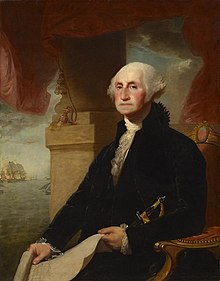
The 1787 Constitution of the United states of america did not specify the mode of address for the president. When George Washington was sworn in as the first president of the United states of america on April 30, 1789, the administering of the oath of office ended with the declaration: "Long alive George Washington, President of the United States."[8] No title other than the proper name of the office of the executive was officially used at the inauguration. The question of a presidential title was being debated in Congress at the time, however, having become official legislative business with Richard Henry Lee's motion of April 23, 1789. Lee's motility asked congress to consider "what titles information technology will be proper to annex to the offices of President and Vice President of the United States – if any other than those given in the Constitution".[9] Vice President John Adams, in his role equally President of the The states Senate, organized a congressional committee. There Adams agitated for the adoption of the style of Highness (as well as the championship of Protector of Their [the United States'] Liberties) for the President.[10] Adams and Lee were amongst the most outspoken proponents of an exalted presidential title.[nine]
Others favored the variant of Balloter Highness or the lesser Excellency, the latter of which was vociferously opposed by Adams, who contended that it was far beneath the presidential dignity, every bit the executives of the states, some of which were also titled "President" (e.yard. the President of Pennsylvania), at that time oft enjoyed the mode of Excellency; Adams said the president "would be leveled with colonial governors or with functionaries from German language princedoms" if he were to employ the manner of Excellency. Adams and Richard Henry Lee both feared that cabals of powerful senators would unduly influence a weak executive, and saw an exalted title as a way of strengthening the presidency.[xi] On further consideration, Adams deemed even Highness insufficient and instead proposed that the executive, both the president and the vice president (i.e., himself), be styled Majesty to prevent the "dandy danger" of an executive with insufficient nobility.[10] Adams' efforts were met with widespread derision and perplexion; Thomas Jefferson called them "the nearly superlatively ridiculous matter I ever heard of", while Benjamin Franklin considered it "absolutely mad".[ten]
Washington consented to the demands of James Madison and the U.s.a. House of Representatives that the title be altered to "Mr. President".[12] [xiii] [14] [15] Nonetheless, after "The Honorable" became the standard title of the President in formal address, and "His/Her Excellency" became the title of the President when addressed formally internationally.
Historically, the title was reserved for the incumbent president only, and was non to exist used for onetime presidents, holding that information technology was not proper to employ the title as a courtesy title when addressing a former president.[16] [17] [xviii] [nineteen] [twenty] According to the official website of the United States of America, the right way to address a letter is to use "The Honorable John Doe" and the correct salutation is "Mr Doe".[21]
In the United States, the championship "Mr. President" is used in a number of formal instances as well: for example anyone presiding over the Us Senate is addressed as "Mr./Madame President", especially the Vice President, who is the President of the Senate. Other uses of the title include presidents of state and local legislatures, still merely the president of the U.s. uses the title outside of formal sessions.
In other countries
Thomas Hungerford, who became the kickoff speaker of the English House of Commons in 1376, used the title, "Mr. Speaker", a precedent followed by subsequent speakers of the Firm of Commons. This influenced parliamentary usage in France.
By the 18th century, the president of a French parlement was addressed every bit "Monsieur le Président". In Pierre Choderlos de Laclos'south 1782 novel Les Liaisons Dangereuses ("Dangerous Liaisons"), the married woman of a magistrate in a parlement is referred to as Madame la Présidente de Tourvel ("Madam President of Tourvel"). When the 2nd French Republic was established in 1848, "Monsieur le Président" became the title of the president of the French Republic.
The speaker of the Firm of Commons of Canada, established in 1867, is also addressed as "Monsieur le Président" or "Madame la Présidente" in French.
Description
The championship president is derived from the Latin prae- "before" + sedere "to sit". Equally such, it originally designated the officer who presides over or "sits before" a gathering and ensures that debate is conducted according to the rules of order (see also chairman and speaker), just today it most ordinarily refers to an executive official in whatsoever social organization. Early examples are from the universities of Oxford and Cambridge (from 1464) and the founding president of the Royal Society William Brouncker in 1660. This usage survives today in the title of such offices as "President of the Board of Trade" and "Lord President of the Council" in the United Kingdom, as well as "President of the Senate" in the United States (ane of the roles constitutionally assigned to the vice president). The officiating priest at sure Anglican religious services, too, is sometimes called the "president" in this sense. However, the near common modern usage is as the title of a head of land in a republic.
In pre-revolutionary France, the president of a Parlement evolved into a powerful magistrate, a member of the so-chosen noblesse de robe ("dignity of the gown"), with considerable judicial as well as administrative authority. The name referred to his primary role of presiding over trials and other hearings. In the 17th and 18th centuries, seats in the Parlements, including presidencies, became effectively hereditary, since the holder of the office could ensure that information technology would laissez passer to an heir by paying the crown a special tax known as the paulette. The post of "beginning president" (premier président), notwithstanding, could be held by only the King's nominees. The Parlements were abolished past the French Revolution. In modern French republic the primary approximate of a courtroom is known equally its president (président de la cour).
The word "presidents" is also used in the King James Bible at Daniel 6:2 to interpret the Aramaic term סָרְכִ֣ין (sā·rə·ḵîn), a discussion of likely Western farsi origin, meaning "officials", "commissioners", "overseers" or "chiefs".
The first usage of the word president to denote the highest official in a authorities was during the Commonwealth of England. Later on the abolition of the monarchy the English Council of State, whose members were elected by the House of Commons, became the executive government of the Commonwealth. The Quango of State was the successor of the Privy Council, which had previously been headed by the lord president; its successor the Council of Country was as well headed past a lord president, the offset of which was John Bradshaw. However, the lord president solitary was not head of land, because that office was vested in the quango equally a whole.
The modern usage of the term president to designate a single person who is the head of country of a democracy can exist traced directly to the United States Constitution of 1787, which created the role of President of the U.s.. Previous American governments had included "presidents" (such equally the president of the Continental Congress or the president of the Massachusetts Provincial Congress), but these were presiding officers in the older sense, with no executive authority. It has been suggested that the executive use of the term was borrowed from early American colleges and universities, which were usually headed by a president. British universities were headed by an official called the "Chancellor" (typically a ceremonial position) while the chief ambassador held the title of "Vice-Chancellor". Only America's starting time institutions of higher learning (such equally Harvard University and Yale University) didn't resemble a full-sized university and so much as ane of its elective colleges. A number of colleges at Cambridge University featured an official called the "president". The head, for instance, of Magdalene College, Cambridge was called the principal and his 2nd the president. The beginning president of Harvard, Henry Dunster, had been educated at Magdalene. Some have speculated that he borrowed the term out of a sense of humility, considering himself but a temporary place-holder. The presiding official of Yale Higher, originally a "rector" (after the usage of continental European universities), became "president" in 1745.
A common style of accost for presidents, Mr/Mrs. President", is borrowed from British Parliamentary tradition, in which the presiding Speaker of the House of Commons is referred to as "Mr/Mrs. Speaker". Coincidentally, this usage resembles the older French custom of referring to the president of a parlement as "Monsieur/Madame le Président", a form of address that in modern France applies to both the president of the Commonwealth and to master judges. Similarly, the Speaker of the Business firm of Commons of Canada is addressed by francophone parliamentarians equally "Monsieur/Madame le/la Président(e)". In Pierre Choderlos de Laclos'south novel Les Liaisons Dangereuses of 1782, the character identified every bit Madame la Présidente de Tourvel ("Madam President of Tourvel") is the married woman of a magistrate in a parlement. The fictional name Tourvel refers not to the parlement in which the magistrate sits, but rather, in imitation of an aristocratic title, to his private estate.
One time the United States adopted the title of "president" for its republican head of state, many other nations followed suit. Haiti became the starting time presidential democracy in Latin America when Henri Christophe causeless the championship in 1807. Almost all the American nations that became contained from Espana in the early 1810s and 1820s chose a US-style president as their chief executive. The first European president was the president of the Italian Democracy of 1802, a customer state of revolutionary France, in the person of Napoleon Bonaparte. The first African president was the president of Liberia (1848),[22] while the first Asian president was the president of the Republic of Mainland china (1912).[23]
In the twentieth and twenty-offset centuries, the powers of presidencies have varied from state to land. The spectrum of power has included presidents-for-life and hereditary presidencies to ceremonial heads of state.
Presidents in the countries with a democratic or representative form of government are usually elected for a specified menstruum of time and in some cases may be re-elected by the same process by which they are appointed, i.due east. in many nations, periodic pop elections. The powers vested in such presidents vary considerably. Some presidencies, such as that of Republic of ireland, are largely formalism, whereas other systems vest the president with substantive powers such equally the date and dismissal of prime ministers or cabinets, the power to declare war, and powers of veto on legislation. In many nations the president is also the commander-in-primary of the nation's armed forces, though once over again this tin range from a ceremonial role to one with considerable authority.
Presidential systems

In almost all states with a presidential system of government, the president exercises the functions of head of country and head of authorities, i.due east. the president directs the executive co-operative of government. When a president is not simply head of country, but too caput of regime, this is known in Europe as a President of the Council (from the French Président du Conseil), used 1871–1940 and 1944–1958 in the Third and 4th French Republics. In the United States the president has ever been both Head of State and Head of Government and has always had the title of President.
Presidents in this system are either direct elected by pop vote or indirectly elected by an electoral college or some other democratically elected body.
In the United States, the president is indirectly elected by the Electoral College made upwards of electors chosen by voters in the presidential election. In most states of the United states of america, each elector is committed to voting for a specified candidate adamant by the pop vote in each state, then that the people, in voting for each elector, are in effect voting for the candidate. However, for various reasons the numbers of electors in favour of each candidate are unlikely to be proportional to the popular vote. Thus, in five close United States elections (1824, 1876, 1888, 2000, and 2016), the candidate with the well-nigh pop votes withal lost the election.

In Mexico, the president is directly elected for a six-year term past popular vote. The candidate who wins the almost votes is elected president even without an absolute majority. The president is allowed to serve only one term. The 2006 Mexican elections had a trigger-happy competition, the electoral results showed a minimal difference between the two most voted candidates and such deviation was just most the 0.58% of the total vote. The Federal Electoral Tribunal declared an elected president afterwards a controversial mail-balloter process.
In Brazil, the president is directly elected for a four-twelvemonth term by pop vote. A candidate has to take more 50% of the valid votes. If no candidates accomplish a bulk of the votes, there is a runoff election between the two candidates with most votes. Once more, a candidate needs a majority of the vote to be elected. In Brazil, a president cannot be elected to more than than 2 consecutive terms, merely there is no limit on the number of terms a president can serve.
Many Due south American, Central American, African and some Asian nations follow the presidential model.
Semi-presidential systems
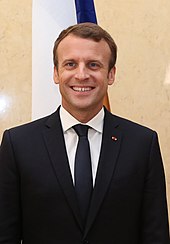
A second system is the semi-presidential organisation, likewise known equally the French model. In this organization, as in the parliamentary system, there are both a president and a prime government minister; merely unlike the parliamentary arrangement, the president may accept significant day-to-mean solar day power. For case, in French republic, when their party controls the majority of seats in the National Assembly, the president can operate closely with the parliament and prime government minister, and piece of work towards a common calendar. When the National Assembly is controlled past their opponents, nevertheless, the president can find themselves marginalized with the opposition party prime minister exercising most of the power. Though the prime number minister remains an appointee of the president, the president must obey the rules of parliament, and select a leader from the house's bulk holding political party. Thus, sometimes the president and prime minister tin be allies, sometimes rivals; the latter situation is known in France as cohabitation. Variants of the French semi-presidential system, developed at the offset of the Fifth Democracy by Charles de Gaulle, are used in France, Portugal, Romania, Sri Lanka and several postal service-colonial countries which take emulated the French model. In Republic of finland, although the 2000 constitution moved towards a formalism presidency, the organisation is still formally semi-presidential, with the president of Finland retaining east.g. foreign policy and date powers.

Parliamentary republics
The parliamentary republic, is a parliamentary system in which the presidency is largely ceremonial with either de facto or no significant executive authority (such as the president of Austria) or de jure no significant executive ability (such as the president of Ireland), and the executive powers rests with the prime number minister who automatically assumes the post every bit head of a majority political party or coalition, but takes adjuration of office administered by the president. Withal, the president is head of the civil service, commander in primary of the armed forces and in some cases tin dissolve parliament. Countries using this system include Austria, Armenia, Albania, People's republic of bangladesh, Czech republic, Germany, Hellenic republic, Hungary, Republic of iceland, Bharat, Ireland, Israel, Italy,[24] Malta, Pakistan, and Singapore.
A variation of the parliamentary republic is a system with an executive president in which the president is the head of country and the government but unlike a presidential system, is elected by and accountable to a parliament, and referred to every bit president. Countries using this arrangement include Republic of botswana, Nauru and South Africa.
Dictatorships
In dictatorships, the title of president is often taken past cocky-appointed or military machine-backed leaders. Such is the example in many states: Idi Amin in Uganda, Mobutu Sese Seko in Zaire, Ferdinand Marcos in the Philippines, Suharto in Republic of indonesia, and Saddam Hussein in Republic of iraq are some examples. Other presidents in authoritarian states have wielded only symbolic or no power such as Craveiro Lopes in Portugal and Joaquín Balaguer under the "Trujillo Era" of the Dominican Commonwealth.
President for Life is a championship causeless past some dictators to try to ensure their authority or legitimacy is never questioned. Presidents like Alexandre Pétion, Rafael Carrera, Josip Broz Tito and François Duvalier died in office. Kim Il-sung was named Eternal President of the Republic after his death.
Commonage presidency

Only a tiny minority of modern republics do not take a single head of country. Some examples of this are:
- Switzerland, where the headship of land is collectively vested in the vii-fellow member Swiss Federal Council, although in that location is as well a president of the Confederation, who is a member of the Federal Council elected by the Federal Assembly (the Swiss parliament) for a twelvemonth (constitutional convention mandates that the mail service rotates every New Year's 24-hour interval).
- The Captains Regent of San Marino elected by the 1000 and General Council.
- In the former Soviet Union from 1922 until 1938 at that place existed an role of commonage caput of state known as the Central Executive Committee of the Soviet Union that consisted of four and subsequently seven chairmen representing the cardinal executive committees of all wedlock republics from Russia, Belarus, Ukraine, Trans-Caucasusia and from 1925 Uzbekistan, Turkmenistan, Tajikistan. From 1927 until 1989 however, real ability was exercised by the Full general Secretary of the Soviet Communist Party. After 1938, the Presidium of the Supreme Soviet executed powers of a collective caput of country, and its chairman was often called "president" in the West, though a atypical head of land named "president" was subsequently established in 1990.
- Yugoslavia after the death of Josip Broz Tito, where a presidency consisting of members from each federal unit ruled the country until its breakup.
- Ukraine, in 1918–1920 in that location existed Directorate composed of seven leaders of parliamentary factions and served as a collective head of land.
- The iii-member Presidency of Republic of bosnia and herzegovina contains a fellow member from each of the country'due south largest ethnic groups and serves as the commonage head of state of Republic of bosnia and herzegovina
- National Council of Government in Uruguay from 1952 until 1967
- Junta of National Reconstruction in Nicaragua from 1979 until 1985
One-party states
The President of Prc is the caput of state of the People's Commonwealth of China. Under the country's constitution, the presidency is a largely formalism function with limited power. However, since 1993, as a thing of convention, the presidency has been held simultaneously past the General Secretary of the Chinese Communist Party, the top leader in the single-party system.
In Prc betwixt 1982 and 2018, the constitution stipulated that the president could non serve more than two consecutive terms. During the Mao era and too since 2018, there were no term limits attached to this function. In 2018, the term limits of the presidency were abolished, merely its powers and formalism office were unchanged.
Presidential symbols
As the land's caput of state, in most countries the president is entitled to sure perquisites, and may have a prestigious residence, often a lavish mansion or palace, sometimes more one (e.k. summer and winter residences, or a country retreat) Customary symbols of office may include an official uniform, decorations, a presidential seal, coat of arms, flag and other visible accessories, as well equally military honours such as gun salutes, ruffles and flourishes, and a presidential guard. A common presidential symbol is the presidential sash worn most often past presidents in Latin America and Africa equally a symbol of the continuity of the office.[25]
Presidential chronologies
United Nations member countries in columns, other entities at the get-go:
- European Commission
- List of presidents of European union institutions
- List of presidents of the Soviet Union (Leaders)
Titles for non-heads of land
As head of authorities
Some countries with parliamentary systems utilize a term pregnant/translating as "president" (in some languages duplicate from chairman) for the head of parliamentary government, ofttimes every bit President of the Government, President of the Quango of Ministers or President of the Executive Quango.
However, such an official is explicitly not the president of the country. These officials are called "president" using an older sense of the discussion, to denote the fact that the official heads the chiffonier. A dissever caput of land generally exists in their country who instead serves as the president or monarch of the country.
Thus, such officials are actually premiers, and to avoid confusion are often described only as 'prime government minister' when beingness mentioned internationally.
There are several examples for this kind of presidency:
- The Prime Minister of Spain is officially referred to equally the president of the Government of Spain, and informally known every bit the "president". Spain is also a kingdom with a reigning king.
- The official title of the Italian Prime Minister is President of the Council of Ministers (Italian Presidente del Consiglio dei Ministri)
- Under the French 3rd and the Fourth Republics, the "President of the Quango" (of ministers – a prime government minister) was the head of government, with the President of the Republic a largely symbolic figurehead.
- From 1963 until 1992, the head of authorities of the Socialist Federal Republic of Yugoslavia was the President of the Federal Executive Council after the 1963 Constitution abolished the role of Prime Minister of Yugoslavia and transferred its functions to the President of the Federal Executive Council. Despite this, foreign media sources continued to refer to individuals property the office of President of the Federal Executive Quango every bit being the "Prime Minister of Yugoslavia".
- The Prime minister of the Irish gaelic Gratis Country from 1922 to 1937 was titled President of the Executive Quango of the Irish Free Country. At the same fourth dimension, the Irish gaelic Free State was a constitutional monarchy with a reigning monarch, the Rex of Ireland, likewise as a resident Governor-General carrying out many head of land functions.
- Under the constitutional monarchies of Brazil and Portugal, the president of the Council of Ministers (Portuguese Presidente practice Conselho de Ministros) was the head of government, with the Monarch beingness the head of State. Nether the Portuguese First and Second Republics, the caput of regime was the president of the Ministry building (Portuguese Presidente do Ministério) and then the president of the Council of Ministers, with the president of the Republic as the head of State.
- The official title of the Croation prime minister is President of the Government of the Democracy of Croatia (Croatian: Predsjednik Vlade Republike Hrvatske).
- The official title of the Polish prime minister is President of the Council of Ministers (Polish Prezes Rady Ministrów).
- In British constitutional practice, the chairman of an Executive Council, interim in such a capacity, is known as a president of the Executive Council. Unremarkably this person is the Governor and it always stays like that.
- Between 1918 and 1934, Republic of estonia had no separate head of land. Both prime number ministers (1918–1920) and country elders (1920–1934) often translated as "presidents") were elected by the parliament.
- The head of government of Islamic republic of iran is styled as the "President". The Iranian head of land is the Supreme Leader, to whom the president is subordinate.
Other executive positions
Sub-national
President can too exist the title of the chief executive at a lower administrative level, such as the parish presidents of the parishes of the U.Southward. state of Louisiana, the presiding fellow member of city council for villages in the U.S. state of Illinois, or the municipal presidents of Mexico'due south municipalities. Perhaps the all-time known sub-national presidents are the civic presidents of the 5 boroughs of New York City.
Poland
In Poland the President of the City (Shine: Prezydent miasta) is the executive authority of the municipality elected in directly elections, the equivalent of the mayor. The Office of the President (Mayor) is too found in Germany and Switzerland.
Russia
Governors of ethnic republics in the Russia used to accept the championship of President, occasionally alongside other, secondary titles such as Chairman of the Government (as well used by Prime Minister of Russia). This likely reflects the origin of Russian republics as homelands for various ethnic groups: while all federal subjects of Russian federation are currently de jure equal, their predecessors, the ASSRs, used to enjoy more privileges than the ordinary krais and oblasts of the RSFSR (such as greater representation in the Soviet of Nationalities). Thus, the ASSRs and their eventual successors would accept more in common with nation-states than with ordinary administrative divisions, at to the lowest degree in spirit, and would cull titles accordingly.
Over the course of the 2010s the presidents of Russian republics would progressively change their title to that of Caput (Russian: глава), a proposition suggested by the president of Chechnya Ramzan Kadyrov and later on fabricated law by the Parliament of Russian federation and President Dmitriy Medvedev in 2010. Despite this, however, presidents of Tatarstan would decline this modify and, equally of 2017, retain their championship in defiance of Russian law. The new title did non consequence in any changes in the powers wielded by the governors.
United kingdom
The lord president of the Quango is ane of the Great Officers of Land in the United Kingdom who presides over meetings of British Privy Council; the Cabinet headed by the prime number minister is technically a commission of the Council, and all decisions of the Chiffonier are formally approved through Orders in Council. Although the lord president is a fellow member of the Chiffonier, the position is largely a ceremonial ane and is traditionally given to either the leader of the House of Eatables or the leader of the Business firm of Lords.
Historically the president of the Lath of Merchandise was a chiffonier member.
Dependencies
In Alderney, the elected caput of government is chosen the president of the States of Alderney.
In the Isle of Man, in that location is a president of Tynwald.
Kingdom of spain
In Spain, the executive leaders of the autonomous communities (regions) are chosen presidents. In each community, they can exist called Presidente de la Comunidad or Presidente del Consejo among others. They are elected by their respective regional assemblies and accept similar powers to a state president or governor.
Deputies
Below a president, there can exist a number of or "vice presidents" (or occasionally "deputy presidents") and sometimes several "banana presidents" or "banana vice presidents", depending on the organization and its size. These posts do not concur the same ability simply more than of a subordinate position to the president. Nonetheless, power tin can be transferred in special circumstances to the deputy or vice president. Normally vice presidents hold some power and special responsibilities below that of the president. The difference betwixt vice/deputy presidents and banana/associate vice presidents is the former are legally allowed to run an organisation, exercising the same powers (as well as being second in command) whereas the latter are not.
Legislatures
In some countries the speaker of their unicameral legislatures, or of one or both houses of bicameral legislatures, the speakers take the title of president of "the body", as in the case of Espana, where the Speaker of the Congress is the president of the Congress of Deputies and the Speaker of the Senate is the president of the Senate.
Judiciary
France
In French legal terminology, the president of a court consisting of multiple judges is the foremost approximate; he chairs the meeting of the court and directs the debates (and is thus addressed as "Mrs President", "Madame la Présidente", "Mr President", or Monsieur le Président. In general, a court comprises several chambers, each with its own president; thus the most senior of these is chosen the "commencement president" (as in: "the First President of the Courtroom of Cassation is the virtually senior estimate in France"). Similarly in English language legal practice the about senior approximate in each partitioning uses this title (e.g. President of the Family Sectionalisation, President of the Court of Appeal).
Spain
In the Spanish Judiciary, the leader of a court of multiples judges is called President of the Court. The same happens with the different bodies of the Castilian judicial arrangement, where we can find a president of the Supreme Court, a president of the National Court and presidents in the Regional Loftier Courts of Justice and in the Provincial Courts. The body that rules over the Judiciary in Spain is the General Quango of the Judiciary, and its president is the president of the Supreme Courtroom, which is usually called President of the Supreme Court and of the GCJ.
The Constitutional Court is non part of the Judiciary, but the leader of information technology is called President of the Ramble Court.
U.k.
In the recently established Supreme Court of the United Kingdom, the nigh senior guess is called the president of the Supreme Court. The lady/lord president of the Court of Session is head of the judiciary in Scotland, and presiding approximate (and Senator) of the Higher of Justice and Court of Session, every bit well as being Lady/Lord Justice Full general of Scotland and head of the High Court of Justiciary, the offices having been combined in 1784.
Spousal or female person titles
Titles for a president's spouse, if female, have ranged from "Marquise" to "Lady" to simply "Mrs." (or "Ms.").[14] If male person the championship of the president's spouse may be "Marquis", "Lord", or merely "Mr.".
The states
President George Washington'southward wife, Martha Washington, was oft called "Lady Washington". By the 1850s in the United States, the term "lady" had changed from a title of nobility to a term of accost for a respected and well-mannered woman. The utilize of "Start Lady" to refer to the wife of the president of the United States was popularized about the time of the Us Civil War. Dolley Madison, the wife of President James Madison, was remembered after her death in 1849 by President Zachary Taylor as "truly our First Lady for a half a century".[26] First ladies are usually referred to only as "Mrs. [last name]" [27]
In the media
On viii Nov 2016, the nighttime of the 2016 presidential ballot in the United states of america, images of leaked pre-printed copies of Newsweek mag showed the magazine celebrating the win of the Democratic candidate Hillary Clinton, with the embrace titled "Madam President". Information technology is common for Newsweek to prepare for the eventuality of either candidate winning, though it was unusual that it was both published and distributed; the cover was pulled from newsstands afterwards it became clear that Donald Trump had secured a bulk of electoral votes, winning the election.[28]
See also
- Eternal President of the Republic
- Presidential system
- Presidents Twenty-four hours
- Requirements for becoming a president
- Vice president
- First Lady
Head of land
- Governor-General
- Head of country
- List of country leaders
- Monarch
- Supreme Leader
Other head of government
- Government minister-President (a head of government, not of state)
- Prime number minister
References
- ^ "Constitution of the Republic of South Africa, 1996 – Chapter 5: The President and National Executive". www.gov.za. 2012. Retrieved 17 April 2019.
- ^ Allard, P (2016). "Authorities social advertisement and ethno-politics in a pocket-sized, ethnically diverse nation". ResearchGate. p. 67. Retrieved 17 Apr 2019.
- ^ Shugart, MS (2008). "Comparative Executive–Legislative Relations". In Folder, SA; Rhodes, RAW; Rockman, BA (eds.). The Oxford handbook of political institutions (PDF). Oxford University Printing. doi:10.1093/oxfordhb/9780199548460.003.0018. ISBN978-0-199548460 . Retrieved 17 Apr 2019.
- ^ "The President, Our Government". The White House. Retrieved 26 April 2021.
- ^ Williams, Stephen P. (2004). How to Be President. Chronicle Books. p. 56. ISBN978-0-8118-4316-4.
- ^ Safire, William (24 November 1991). "On Language; Manhandling the Handlers". The New York Times.
- ^ Forest, Lewis (13 May 1945). "Mr. President Is correct". The New York Times.
- ^ Bartoloni-Tuazon, Kathleen (2014). For Fear of an Elective Male monarch. Ithaca: Cornell Academy Press. p. 89.
- ^ a b Bartoloni-Tuazon, Kathleen (2014). For Fright of an Elective King. Ithaca: Cornell University Press. p. 86.
- ^ a b c Hutson, James H. (March 1968). "John Adams' Title Campaign". The New England Quarterly. 41 (1): 30–39. doi:10.2307/363331. JSTOR 363331.
- ^ Bartoloni-Tuazon, Kathleen (2014). For Fear of an Elective King. Ithaca: Cornell Academy Printing. p. 57.
- ^ Hart, Albert Bushnell (1897). Formation of the Union, 1750–1829. Longmans. p. 143. ISBN1-4069-2845-3.
- ^ Martin, Judith (2003). Star-spangled Manners. W.W. Norton & Co. p. 67. ISBN978-0-393-04861-2.
- ^ a b Wood, Gordon Due south. (2006). Revolutionary Characters. Penguin Press. p. 54. ISBN978-1-59420-093-9.
- ^ Caroli, Betty Boyd (2003). First Ladies. Oxford University Press The states. p. four. ISBN978-0-19-516676-seven.
- ^ Martin, Judith (21 Jan 2009). "Miss Manners by Judith Martin". The Washington Post . Retrieved 18 May 2019.
- ^ "Presidents, Vice Presidents, and First Ladies of the U.s. | USAGov". www.u.s.a..gov . Retrieved 24 August 2020.
- ^ Martin, Judith (21 October 1992). "Addressing a Former President". The Washington Post. Archived from the original on 10 June 2014. Retrieved 5 January 2013.
- ^ Hickey, Robert. "Is a Old President Addressed as President (name)?". Honor & Respect – The Official Guide to Names, Titles, and Forms of Accost. Protocol Schoolhouse of Washington. Retrieved 5 January 2013.
- ^ Keller, Kerrie (5 January 2013). "Addressing a Old President of the United States". The Emily Postal service Found. Retrieved 5 Jan 2013.
When addressing a former President of the United States in a formal setting, the correct form is "Mr. LastName". ("President LastName" or "Mr. President" are terms reserved for the electric current head of state.)
- ^ "Presidents, Vice Presidents, and First Ladies of the Us".
- ^ Emma J. Lapsansky-Werner and Margaret Hope Bacon, eds., Back to Africa: Benjamin Coates and the Colonization Motility in America: 1848–1880. Land College PA: Pennsylvania Land Press, 2010. 57–59. ISBN 9780271045719 books.google.com/books?id=9X0rc6E9EGkC&pg=PA57
- ^ Xu Guoqui, China and the Corking War: China'south Pursuit of a New National Identity and Internationalization. Cambridge University Printing, 2005. 319. ISBN 9780521842129 books.google.com/books?id=erOGMb8c4XEC&pg=PA319
- ^ Merely presidential moral suasion is increasingly confirming that the "neutral powers", in this country, often find in the head of country the all-time defender from executive interference: Buonomo, Giampiero (2014). "Autorità indipendenti e sistema costituzionale". L'Ago east Il Filo. Archived from the original on 24 March 2016. Retrieved 12 April 2016.
- ^ McCullough, J. J. "Presidential Sashes". Archived from the original on 23 January 2017. Retrieved 19 February 2017.
- ^ Mayo, Edith (1996). The Smithsonian Book of the Outset Ladies. H. Holt. p. 33. ISBN978-0-8050-1751-9.
- ^ "President Donald J. Trump and First Lady Melania Trump Welcome Governors to the White House". whitehouse.gov. Executive Office of the President. 26 February 2017. Retrieved 22 March 2017.
Mrs. Trump added that, "the scents of jasmine and roses fill the air every bit we requite thanks for this slap-up Nation and the glory of renewal."
- ^ Greenslade, Roy (x November 2016). "Madam President: how Newsweek reported a Clinton victory". The Guardian. ISSN 0261-3077. Retrieved 17 November 2016.
Source: https://en.wikipedia.org/wiki/President_(government_title)
0 Response to "Mr President You Are Correct Again"
Post a Comment